Blog
November 24, 2026
Using data from Inductive’s ADMET consortium to evaluate KERMT
Inductive’s pre-competitive ADMET consortium powers our state-of-the-art prediction algorithms. For the first time, we’re sharing results from using our consortium data in a privacy-preserving architecture to evaluate the performance of a third-party algorithm, KERMT. Working with the NVIDIA BioNeMo team, we show that KERMT outperforms an industry-standard baseline, examine where its improvements are greatest and what drives them, and provide a proof of concept for future evaluations of AI models using our unique dataset.


Inductive’s pre-competitive ADMET consortium powers our state-of-the-art prediction algorithms. For the first time, we’re sharing results from using our consortium data in a privacy-preserving architecture to evaluate the performance of a third-party algorithm, KERMT. Working with the NVIDIA BioNeMo team, we show that KERMT outperforms an industry-standard baseline, examine where its improvements are greatest and what drives them, and provide a proof of concept for future evaluations of AI models using our unique dataset.
Inductive’s pre-competitive ADMET consortium is key to the state-of-the-art performance of our Beacon models, which have beaten more than 1,000 competitors to take first place in all four ADMET competitions run by OpenADMET. But the value of this dataset extends beyond model training. Spanning a significant number of programs from dozens of biopharma companies, its diversity across modern drug discovery makes it uniquely well-suited for evaluating how well ADMET prediction algorithms generalize across chemical space.
Because this data is confidential intellectual property belonging to our partners, it can never be released to the public. However, we routinely use it internally to evaluate algorithmic ideas as we build and refine our Beacon models. Now, for the first time, we're extending this practice to a research collaboration with NVIDIA's BioNeMo team, using a privacy-preserving architecture.
NVIDIA develops and accelerates AI models for applications in the biopharma industry. Recently, Merck developed Kinetic GROVER Multi-Task (KERMT), a chemical foundation model for small-molecule property prediction enabled by NVIDIA BioNeMo. It uses a 50M parameter dynamic message passing graph transformer architecture backbone and can be finetuned in a multi-task setting to learn and predict correlated drug property tasks like ADMET endpoints.
In the original KERMT publication, the model was compared with other models, including Chemprop, using public data and Merck’s proprietary dataset. To further evaluate its performance, we compared KERMT with Chemprop on a curated subset of our consortium dataset.*
A challenging, real-world cross-biopharma dataset
To rigorously assess KERMT’s performance, we used a curated subset of our pre-competitive consortium dataset, comprising compounds contributed by dozens of biopharma companies across a large number of discovery projects and spanning 29 assay endpoints. Aggregating data from multiple partners introduces significant real-world complexity: differences in ADMET assays and protocols require careful data harmonization and result in a highly sparse dataset. To ensure a realistic prospective evaluation, we used a partner-stratified temporal split to create our training, validation, and test sets, holding out the 21,000 most recently measured compounds from this subset for testing. Figure 1 shows the distribution of test compounds’ similarity to their nearest neighbors in the training set.
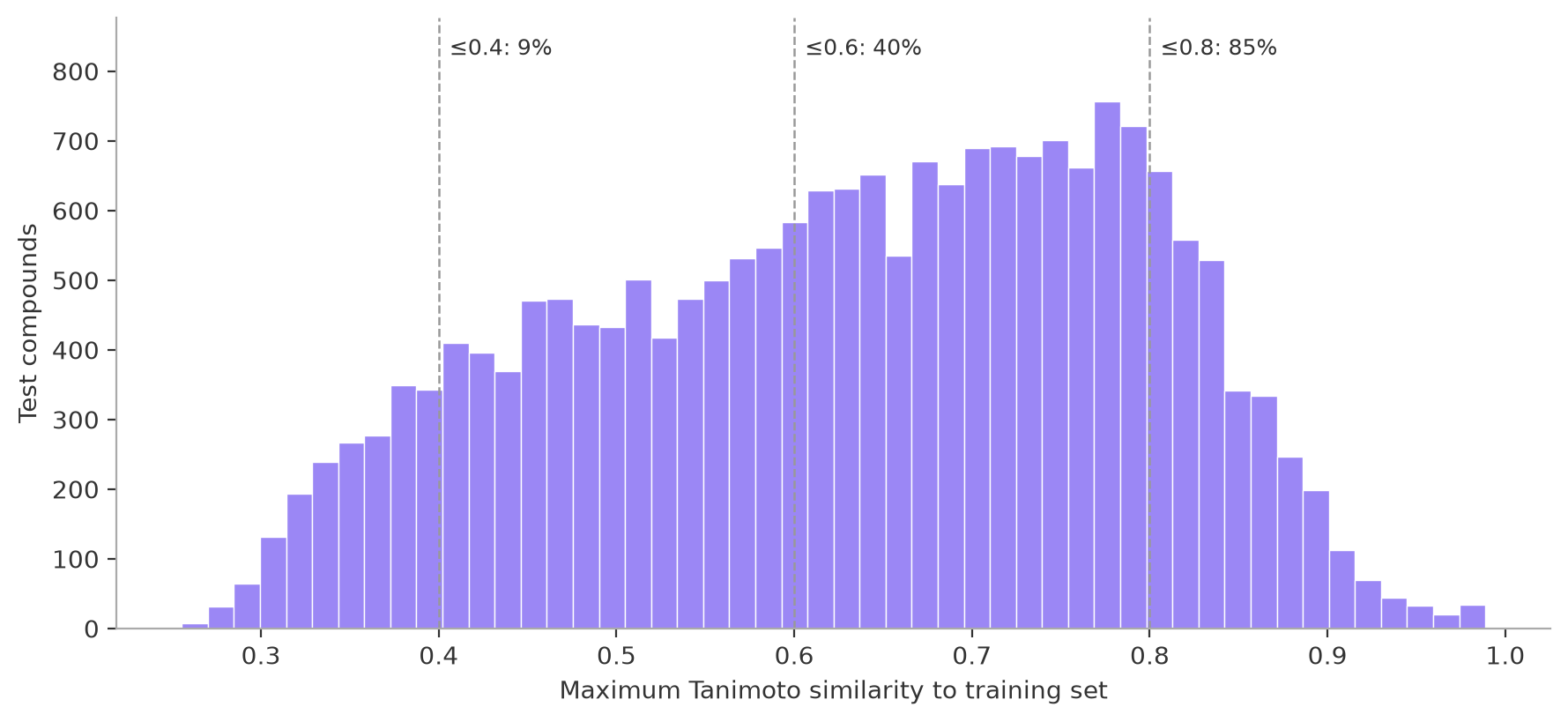
We compared KERMT against Chemprop, a widely used directed message-passing neural network (D-MPNN) that has become the de facto industry standard for ADMET prediction.† KERMT is a pretrained graph transformer with 50 million parameters, compared with Chemprop's 365,000. Both models were trained and tested on identical data, with all 29 tasks trained jointly. Our evaluation focused on two metrics: Spearman’s rank correlation, which measures the model’s ability to rank compounds, and mean absolute error (MAE), which measures the accuracy of its absolute predictions.
KERMT shows large improvements across ADMET categories
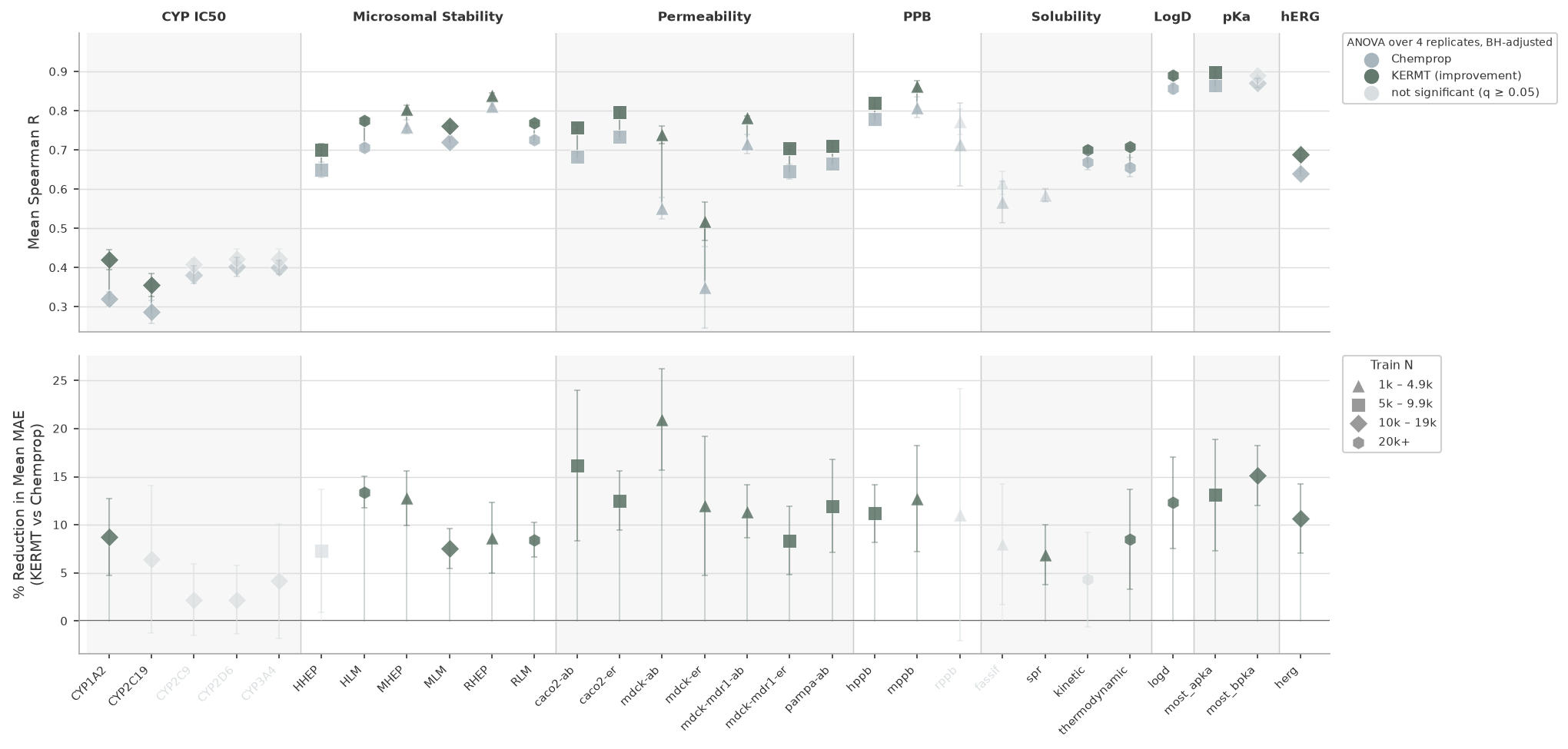
In our analyses, KERMT outperformed the Chemprop baseline across all 29 ADMET endpoints. On average, KERMT improved Spearman’s rank correlation from 0.64 to 0.69 (+9%), with statistically significant gains on 22 of 29 endpoints (ANOVA with Benjamini-Hochberg correction), as shown in Figure 2. KERMT also achieved lower mean absolute error (MAE) across all endpoint categories, reducing average MAE from 0.584 to 0.526 (-10%). The largest improvements were in permeability, physicochemical properties (pKa and LogD), and hERG.
Where KERMT wins
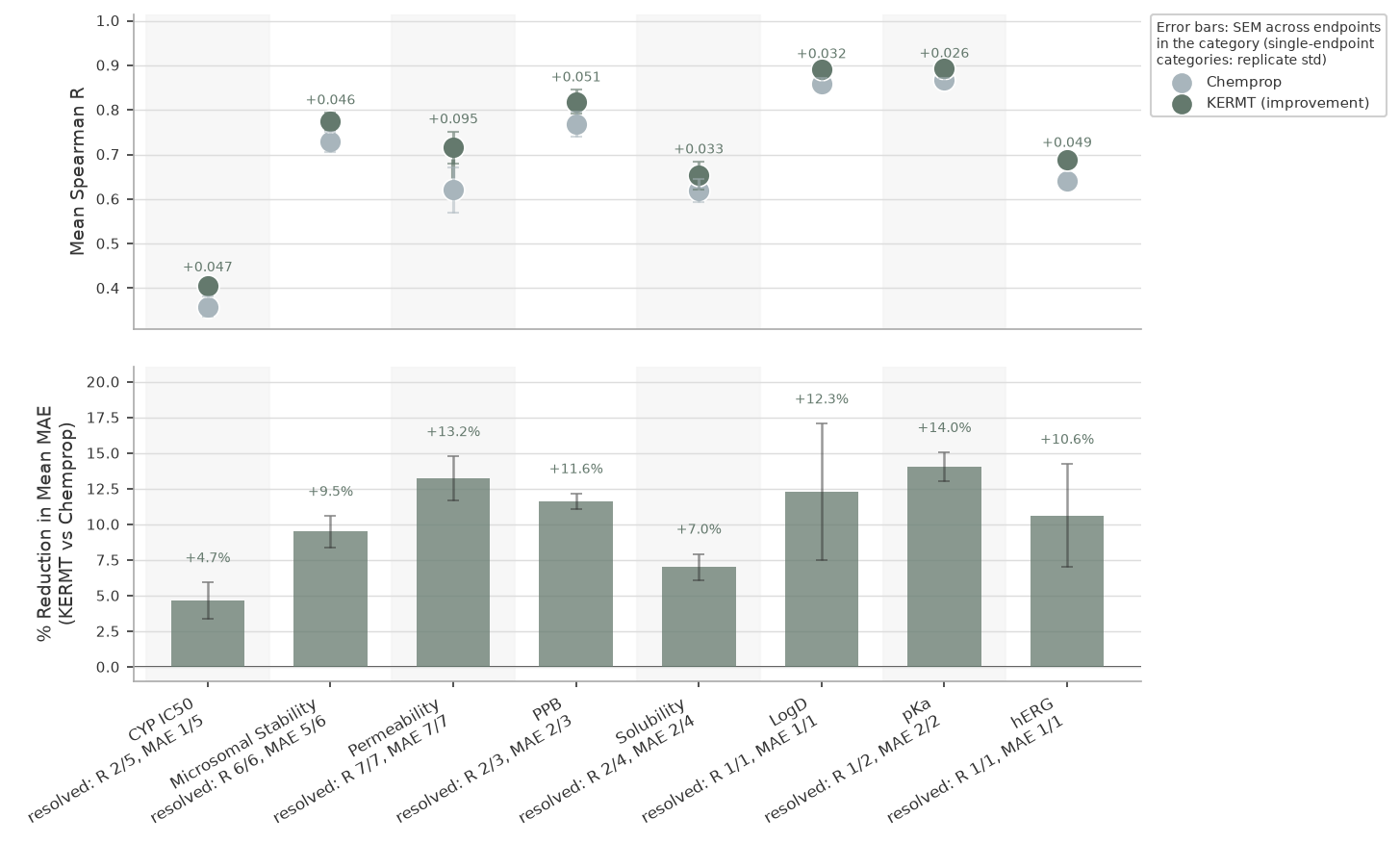
KERMT’s gains are concentrated in properties for which whole-molecule context matters (Figure 3). The largest improvement in rank correlation is in permeability, where Spearman’s R increased from 0.62 to 0.72 (+15%), while MAE for LogD and pKa fell from 0.475 to 0.417 (-12%) and from 1.005 to 0.864 (-14%), respectively, despite Chemprop’s already strong ranking performance on these properties (Spearman’s R > 0.85). KERMT also improves predictions for CYP450 and hERG inhibition, improving mean Spearman’s R for CYP IC50 endpoints from 0.36 to 0.41 (+13%) and reducing MAE for hERG from 0.400 to 0.358 (-11%).
KERMT improves permeability ranking by 15%
While KERMT improves on the predictive performance of Chemprop across all categories, the permeability category stands out, with the largest gain in Spearman's R of any category, increasing from 0.62 to 0.72 (+15%), and a reduction in average MAE from 0.466 to 0.404 (-13%).
For individual endpoints such as MDCK efflux ratio, Spearman's R improves from 0.35 to 0.52 (+49%). The improvement is consistent across the category: KERMT significantly outperforms Chemprop in both Spearman's R and MAE on all seven permeability endpoints (ANOVA + Benjamini-Hochberg, q < 0.05). Permeability is a whole-molecule property that KERMT’s internal representation is capable of capturing, through its combination of dynamic-depth attention-based message passing and whole-molecule descriptors; we examine how much these contribute below.
Larger molecules show promising improvements in permeability
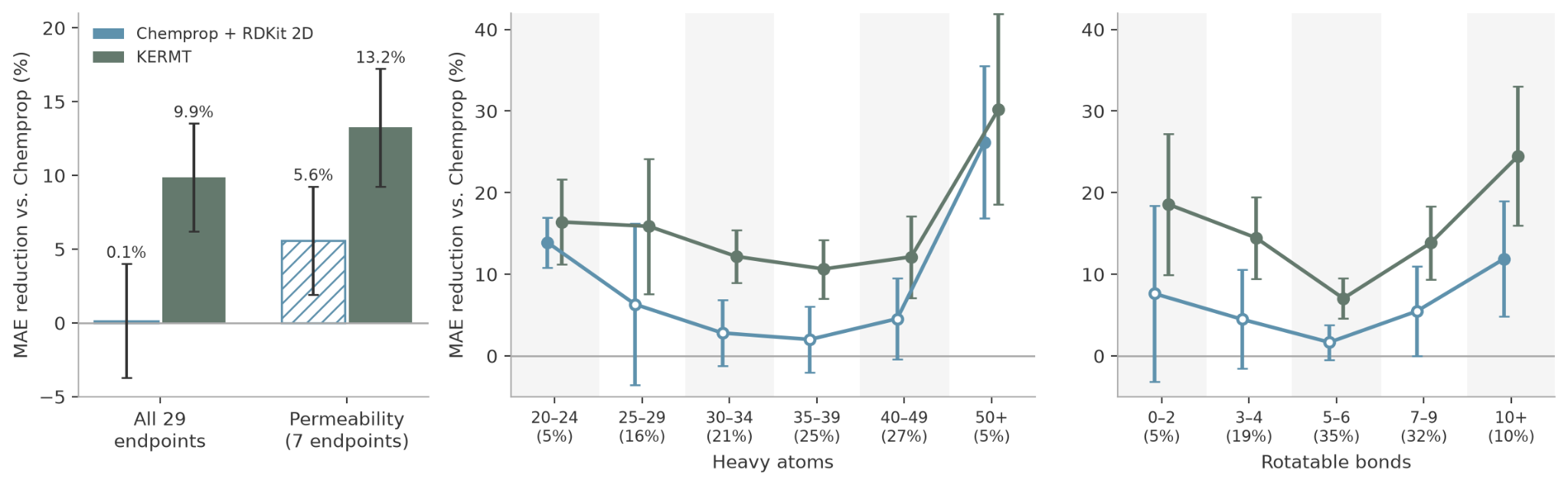
KERMT’s advantage was generally consistent across molecular size and shape, but it was most pronounced for larger and more flexible molecules in permeability prediction (Figure 4). For molecules with 50 or more heavy atoms, KERMT reduced permeability MAE from 0.591 to 0.413 (-30%), compared with 0.466 to 0.404 (-13%) across the permeability category. A similarly strong gain was seen for molecules with 10 or more rotatable bonds, where MAE fell from 0.508 to 0.383 (-25%). These results suggest that KERMT may better capture molecular properties relevant to permeability, particularly for larger molecules, although this analysis is not sufficient to conclusively establish this trend.
Whole-molecule descriptors explain part of KERMT’s permeability advantage
Unlike Chemprop, KERMT incorporates 200 RDKit descriptors alongside its learned molecular representation, providing additional information about properties such as molecular weight, polar surface area, and flexibility. We retrained Chemprop with the same descriptors added to its prediction head to interrogate the contribution of these features. Chemprop trained with these 200 RDKit descriptors reduced permeability MAE from 0.466 to 0.440 (-6%), recovering approximately 40% of KERMT’s improvement (0.466 to 0.404, -13%) (Figure 4). The benefit was particularly pronounced for larger molecules, where descriptor-augmented Chemprop reduced MAE from 0.591 to 0.437 (-26%), compared with 0.413 (-30%) for KERMT. However, adding descriptors to Chemprop did not yield a statistically significant improvement in permeability after multiple-testing correction and provided little benefit for other ADMET properties. These findings suggest that whole-molecule descriptors contribute to KERMT’s advantage, while other architectural and training differences likely account for the remaining gains.
KERMT accurately predicts physicochemical properties
A good molecular representation should have good latent representation of molecular physicochemical properties as they dictate multiple downstream ADMET properties. KERMT's internal molecular representation improves prediction of physicochemical properties, reducing MAE from 1.005 to 0.864 (-14%) for pKa (two endpoints), from 0.475 to 0.417 (-12%) for LogD (one endpoint), and from 0.595 to 0.553 (-7%) for solubility (four endpoints). As physicochemical properties are upstream drivers of ADMET behavior, accurate prediction of them serves as a litmus test for a model's ability to predict other ADMET properties.
Similarity to the training set matters most
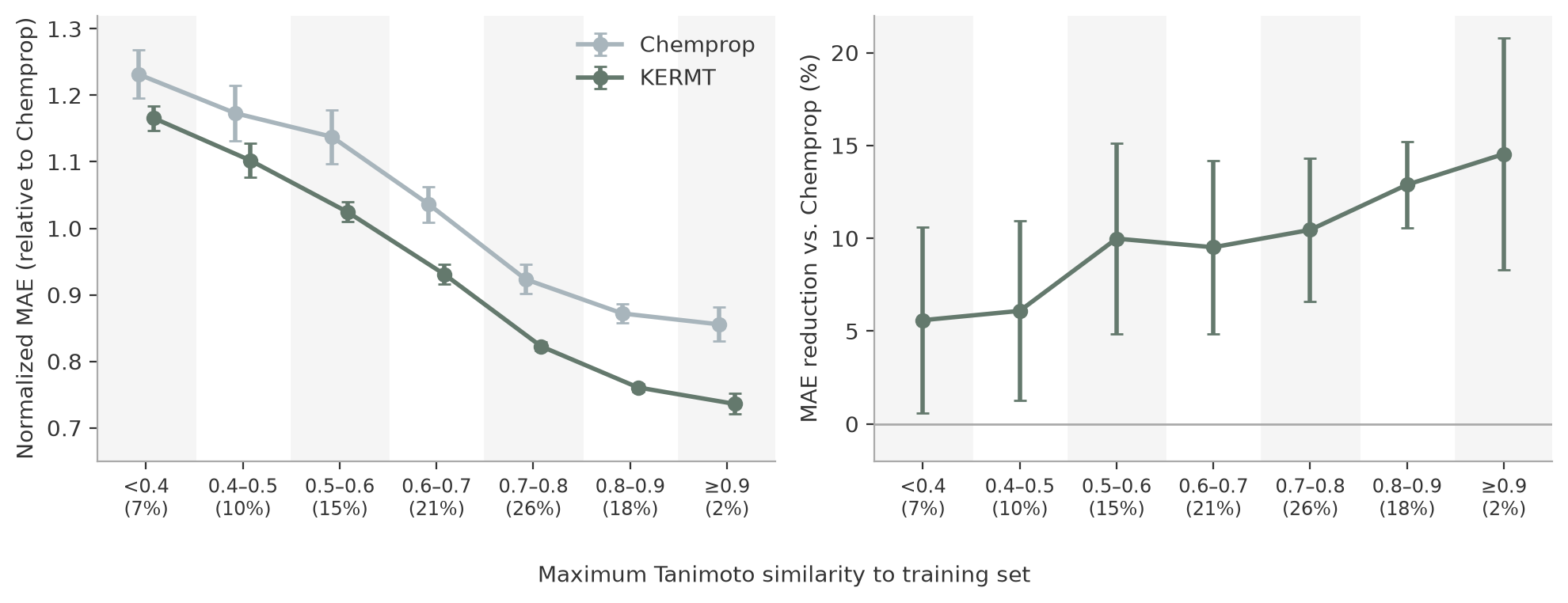
We evaluated how similarity to the training set affects KERMT’s improvements over Chemprop across all endpoints (Figure 5). KERMT reduces MAE over Chemprop from 0.516 to 0.441 (-15%) for compounds that are highly similar to the training compounds (Tanimoto similarity ≥ 0.9), compared with 0.683 to 0.633 (-7%) for compounds with similarity below 0.5. While both models perform better on molecules closer to the training data, KERMT shows a larger advantage in this regime. This is particularly relevant for lead optimization, where new compounds are typically designed through small structural modifications to previous molecules.
The bottom line
In this independent benchmark on a dataset reflecting the diversity of modern drug discovery, KERMT consistently outperformed Chemprop across 29 ADMET endpoints. We found particularly strong improvements in permeability prediction, explored the contribution of whole-molecule descriptors to these gains, and showed that KERMT's advantage was greatest for compounds similar to the training set, where accurate predictions are especially valuable during lead optimization.
Beyond the performance of KERMT itself, this collaboration demonstrates the value of Inductive's pre-competitive ADMET consortium as a resource for evaluating AI models. By bringing together data from diverse drug discovery programs across dozens of biopharma companies, the consortium enables rigorous comparisons on real-world chemical data, as well as insights into where models are particularly strong. This collaboration provides a proof of concept for how we can work with external researchers to evaluate medicinal chemistry capabilities of models on proprietary industrial-scale datasets while protecting our partners' confidential data.
- QC analytical reports (1H/13C/19F/2D NMR, chiral SFC)
- Propose, visualize, and triage forward and retrosyntheses
- Monitor the synthesis queue and flag stalled targets
- QC assay data as it lands and flag suspicious results
- Prioritize repeats and nominate compounds for downstream assays
- Analyze SAR and identify data gaps
- Evaluate IVIVC and suggest diagnostic experiments
- Design, enumerate, and triage analogs
- Launch and analyze physics-based workflows like docking and FEP
- Project human PK and efficacious dose
- Answer questions about a program’s history (what was learned and when)
- Track team progress against the target candidate profile
- Get new scientists up to speed on a program
- Make meeting-ready slides and figures
Prompt: I’m attaching two files with activity data, one with new data from today and one with historical data. Can you look through the new data and identify any QC issues that I should be aware of? Create a csv where every compound + assay run pair is labeled with any relevant issues.
Prompt: Do a nitrogen walk around the core of this molecule: O=C(NCC1=CC=C(C)C(F)=C1)C2=CC=C3C=C(N4[C@H](C)CCCC4)C=CN32
Prompt: Do an OH walk around this whole molecule: O=C(NCC1=CC=C(C)C(F)=C1)C2=CC=C3C=C(N4[C@H](C)CCCC4)C=CN32
Prompt: Replace the core of this molecule with this set of 5,6-ring systems (file attached): O=C(NCC1=CC=C(C)C(F)=C1)C2=CC=C3C=C(N4[C@H](C)CCCC4)C=CN32
[Related posts]
September 17, 2026
Blog
Beacon-2: Completing the reward function for chemical optimization in drug discovery
Dose is the primary reward function of pre-clinical discovery, and we believe that making it computable via Beacon-2 is a step change for AI in drug discovery. Now, instead of optimizing individual properties in isolation, agentic systems can drive the drug discovery process itself.
September 14, 2026
Blog
Meet Indy: an AI chemistry assistant designed by medicinal chemists to do medicinal chemistry
Indy, our medicinal chemistry assistant, supports drug discovery programs in improving the rigor of day-to-day analyses and decisions, by QC-ing assay data and monitoring the synthesis queue, to launching FEP, projecting human dose, and making meeting-ready SAR and synthesis slides.
August 1, 2024
Blog
Are local or global models better? Why not both?
A long-standing debate in cheminformatics is whether global property-prediction models perform better or worse than local QSAR models. We describe a result from our publication with Nested Therapeutics in which we show that the best of both worlds is to train a model on global data and then fine-tune it on local data.
June 7, 2024
Blog
Approaching AlphaFold 3 docking accuracy in 100 lines of code
AlphaFold 3 (AF3) is an exciting leap forward in our ability to predict the structure and properties of biomolecular systems. We explore how AF3 small-molecule docking compares to existing techniques and find that the story is more nuanced than headlines suggest. We conclude with thoughts on where AF3 may ultimately be most useful.
November 20, 2023
Blog
Get with the program: building ADME datasets that drive impact
Research advances often don't translate to practical impact. In ML for small molecule drug discovery, this is at least partly because benchmark datasets don't capture important components of drug programs. We show how this can happen in ADME prediction and provide a path forward for building more realistic benchmarks from existing public data.